Penn Translational Neuroscience Center

Biobank

We house the Penn Translational Neuroscience Center Biobank, which provides biofluid samples to researchers within the Penn community and throughout the world.

What is in the collection

Counts current to 28 January 2026.

Human-derived specimens, collected over many years, flow into one central biobank from four disease cohorts: Alzheimer's disease and mild cognitive impairment (n=3,134), Parkinson's disease and dementia with Lewy bodies (n=2,189), frontotemporal degeneration (n=1,689) and amyotrophic lateral sclerosis (n=612) — more than 7,000 participants in all.

Of those, 7,112 have contributed DNA, 7,053 plasma, 2,959 CSF and 2,162 brain tissue. Many have given more than one, which is what makes paired comparisons across biofluids possible.

To request samples, complete the BioSample Request form below and email it to the biobank. Requests are reviewed against the diagnostic criteria and sample counts you specify, and rare or highly specific types of cases may not be available.
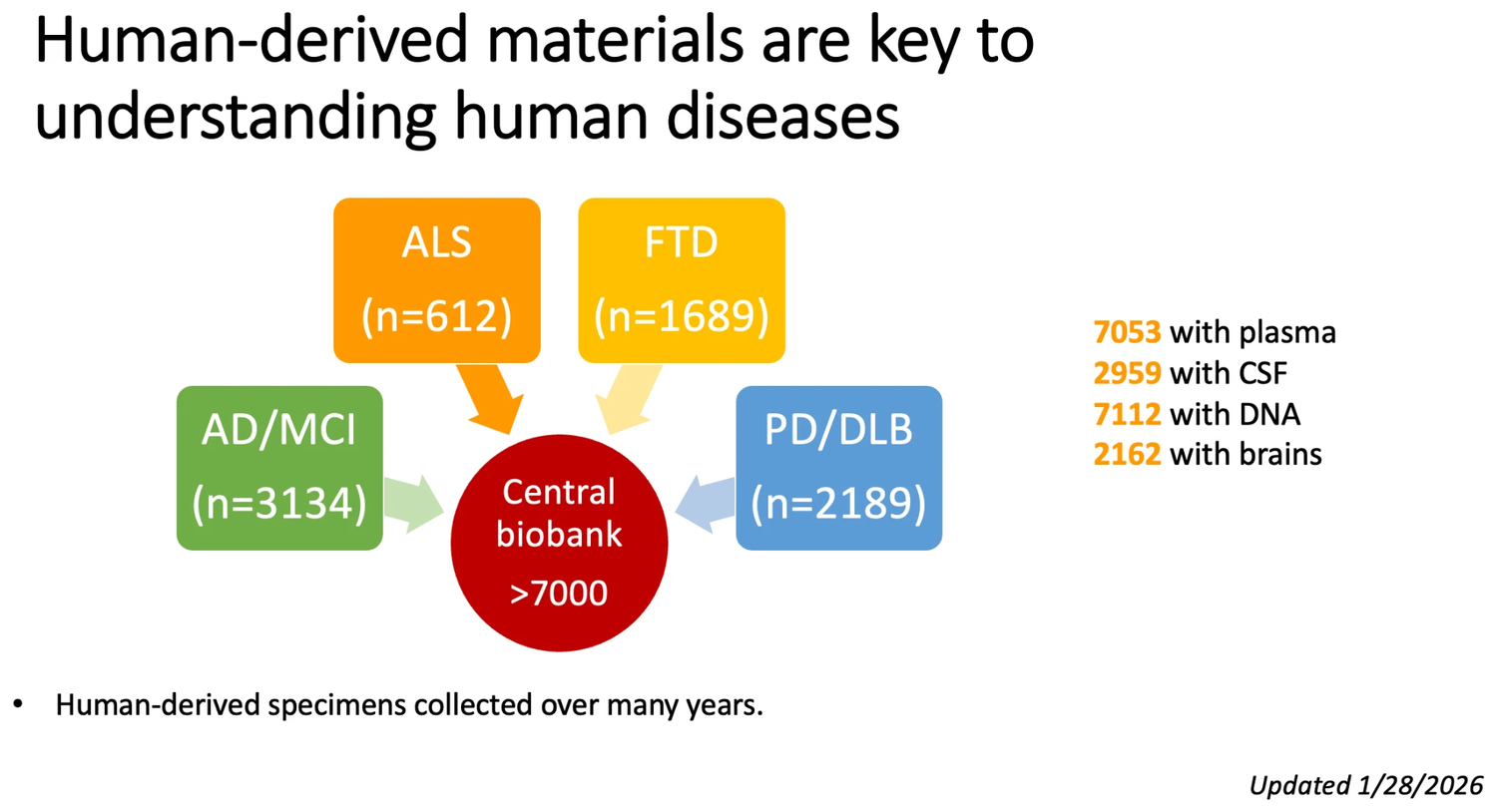
Four disease cohorts feed a central biobank of more than 7,000 participants: AD/MCI n=3,134, PD/DLB n=2,189, FTD n=1,689 and ALS n=612. Of these, 7,053 have plasma, 2,959 CSF, 7,112 DNA and 2,162 brains.

Forms and protocols

UPenn BioSample Request form

Request formVersion 5.2026

The form external investigators complete to request samples. It covers investigator and institution details, the research project and its funding, IRB approval, diagnostic criteria for case selection, sample types and counts, the database fields returned with each sample, a project summary, and the publication, data-return, financial and legal terms.

Biobanking Saliva Collection Protocol

Protocol11 October 2023

Receiving and heat-inactivating mailed saliva samples for DNA extraction, using the Oragene-Discover OGR-500 kit.

How a delivered sample is triaged

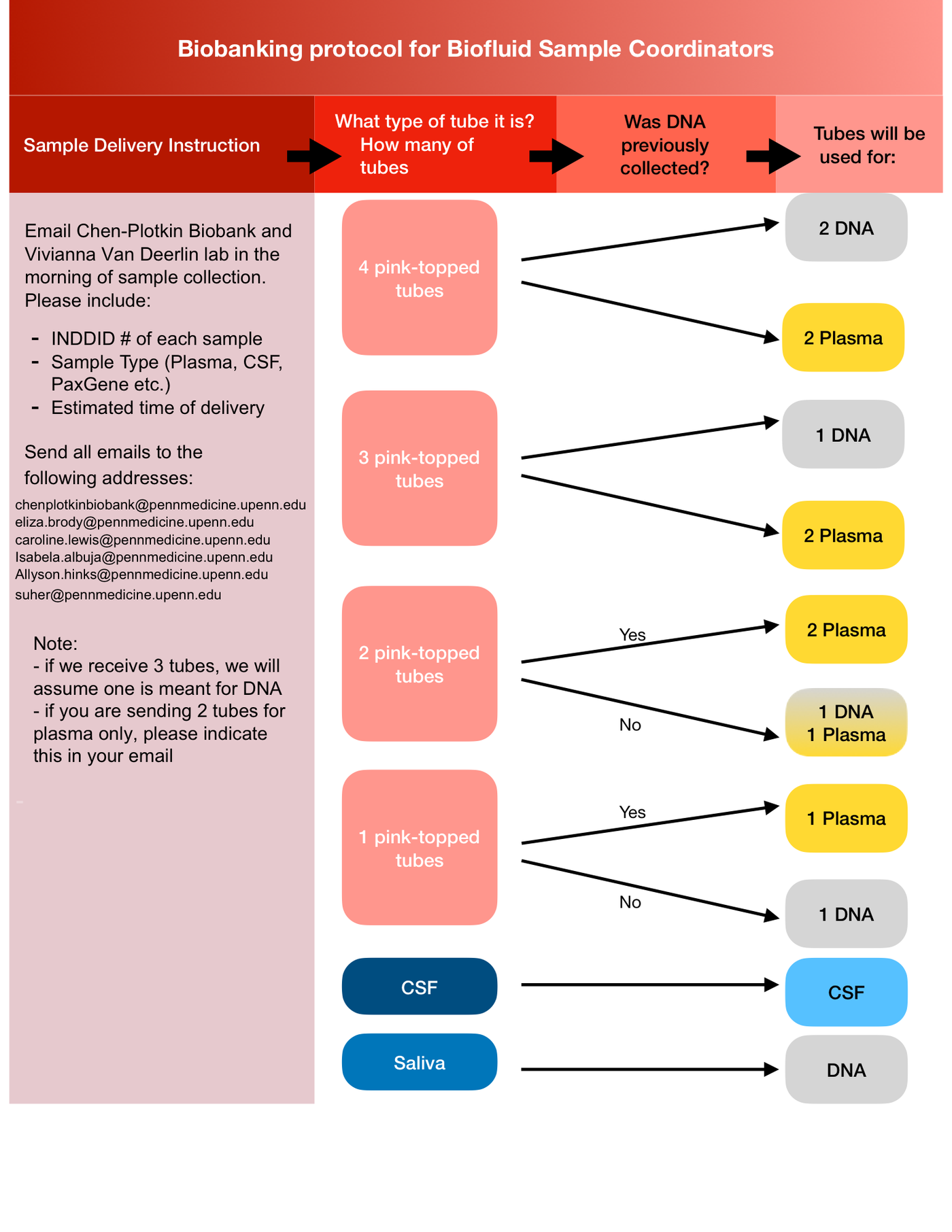
Biobanking protocol flowchart for biofluid sample coordinators: what to email ahead of collection, and how pink-topped blood tubes, CSF and saliva map onto DNA and plasma aliquots.

To request samples or ask about the collection protocols, write to chenplotkinbiobank[at]pennmedicine.upenn.edu.